
Botox vs. Dysport vs. Xeomin vs. Letybo: Which Neurotoxin Works Best for Alameda Patients?
Overview
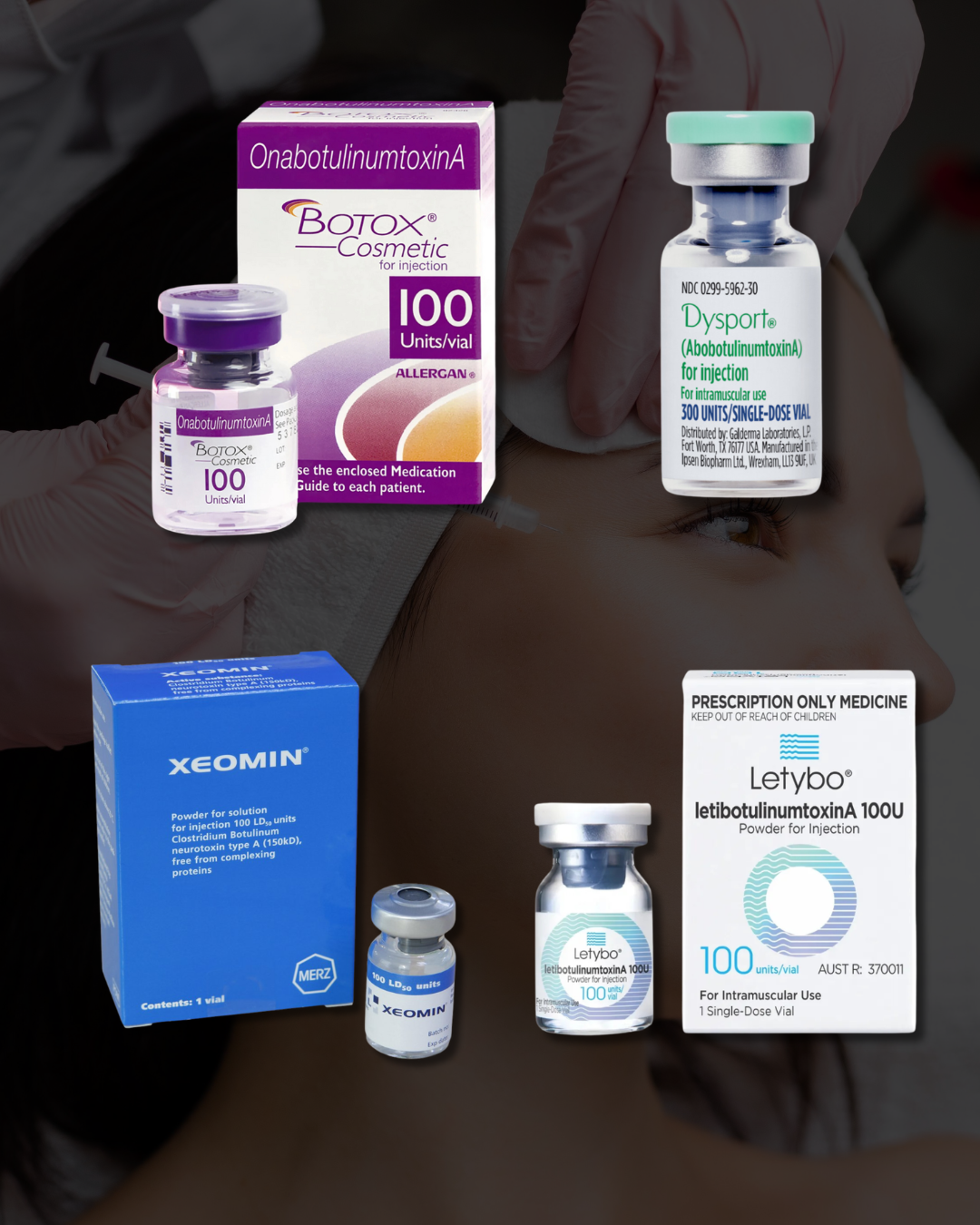
Your injector's skill matters more than the brand in the syringe. All four products are FDA-approved neuromodulators derived from botulinum toxin type A.
Botox: precision standard with a full protein coating
Dysport: spreads further and kicks in faster for broad muscle groups
Xeomin: "naked" toxin stripped of complexing proteins, ideal for patients who have built resistance
Letybo: newest FDA-approved option, my preferred Botox alternative for its lower cost and different protein structure
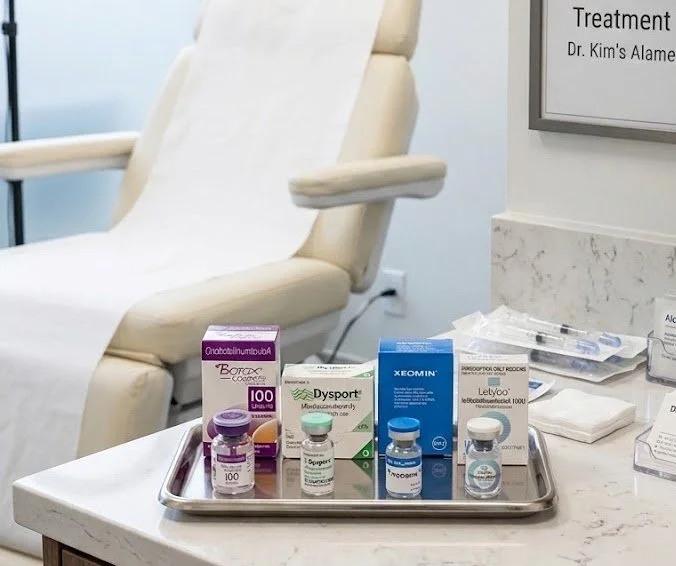
All four stocked at my Alameda office at 1403 Park Street, because different faces need different tools
1. These Are Not Interchangeable Products
Patients assume swapping one neurotoxin for another is like switching from Advil to generic ibuprofen. This assumption misses the point.
The active molecule in all four products is botulinum toxin type A. Botox carries a heavy complement of protective proteins, making it stable and predictable.
When I inject it into the glabella (the "11 lines" between your eyebrows), it stays right where I place it. Dysport has fewer protective proteins, a smaller molecular weight, and tends to diffuse further from the injection point. Xeomin strips away the complexing proteins entirely, leaving pure neurotoxin. Letybo, developed by Hugel in South Korea, behaves most similarly to Botox in my hands, with controlled spread and a standard onset timeline.
2. Speed of Onset Varies by Product
Dysport tends to kick in fastest. Clinical data and my own observations put onset at 2 to 3 days, compared to 5 to 7 days for Botox, with full effect sometimes taking up to two weeks to settle in.
A Bay Farm patient came into my Park Street office needing her forehead smooth before a weekend fundraiser on Bay Farm Island. Three days to work with. I reached for Dysport because waiting a full week for Botox to ramp up was not an option.
Xeomin and Letybo follow closer to the Botox timeline. You'll see some softening around day 3 or 4, but peak effect comes later. My preference is to treat patients two weeks before a major event, giving me time for a touch-up if one brow pulls harder than the other. When time is tight, the product choice shifts.
3. Toxin Resistance Is Real, and Xeomin Solves It
I see patients who have been getting Botox faithfully every three to four months for a decade. Then it stops working. The treatment wears off in four weeks, or never kicks in at all.
This happens because the body creates neutralizing antibodies against the complexing proteins surrounding the active molecule. Your immune system tags those proteins as foreign invaders and attacks them before the toxin reaches the muscle.
Xeomin removes those complexing proteins during manufacturing, presenting almost nothing for the immune system to target. I switch patients to Xeomin as soon as they report diminishing returns with Botox, and the results often return immediately. Letybo offers another option here, since its protein structure differs from Botox's, meaning the same antibodies don't always cross-react.
4. Precision vs. Coverage: Choosing by Anatomy
Dysport's tendency to spread is a feature when treating a broad, strong forehead, especially on male patients with heavy muscle recruitment. I want the product to feather out evenly across the whole area rather than leaving a frozen patch in the center with movement on the sides.
The same spread becomes a liability near the eyes or mouth. If toxin drifts near the levator muscle of the upper eyelid, it causes ptosis, a droopy eyelid taking weeks to resolve. For crow's feet, lip lines, and any area requiring pinpoint accuracy, I prefer Botox, Letybo, or Xeomin because their tighter diffusion radius keeps the product exactly where I place it.
This is why you want a board-certified plastic surgeon handling your injections. I assess muscle strength, skin thickness, and facial anatomy before opening any vial, and the product I choose depends on what your face needs.
5. Why I Prefer Letybo as My Botox Alternative
Letybo (LetibotulinumtoxinA-wlbg) received FDA approval after years as the market leader in South Korea, where aesthetic standards for injectables are among the highest in the world. Hugel, the manufacturer, built a long track record with this product before bringing it to the US market.
In my practice, Letybo's results are indistinguishable from Botox for most patients, with similar duration at 3 to 4 months. Where Letybo stands apart is cost. It comes in at a lower price point than Botox, and its different protein structure means patients concerned about long-term antibody development have a meaningful alternative without switching to the spreading characteristics of Dysport or the stripped-down formulation of Xeomin.
If you like how Botox works on your face but want to save on treatment costs, or if you're looking for a rotation strategy to reduce resistance risk, Letybo is the first product I recommend to my Alameda patients.
6. Duration and Cost: The Numbers That Matter
All four products last about 3 to 4 months in clinical practice, regardless of what marketing materials claim. Metabolism plays a significant role. My Alameda patients who row on the estuary or hit high-intensity workouts at their East End gym tend to burn through their neurotoxin faster because their metabolic rate clears the product from the system more quickly.
Comparing cost per unit across brands is misleading because the unit counts are not equivalent:
Botox, Xeomin, and Letybo use similar unit dosing (roughly 20 units for the glabella)
Dysport requires 50 to 60 units for the same effect
Most practices price Dysport so the total treatment cost comes out comparable to Botox
A "cheaper" per-unit price on Dysport does not mean a cheaper treatment when you need three times as many units. Focus on total treatment cost, not the per-unit number.
Not sure which neurotoxin fits your goals? Call Dr. Roy Kim at 415-362-1846 to schedule a consultation at my Alameda office at 1403 Park Street.
Myths About Neurotoxins
"All four brands are the same thing in different bottles." Wrong. The active molecule is identical, but the protein coating, molecular weight, and diffusion behavior differ significantly. Those differences change which product I choose for which area of your face.
"Dysport will make you look more frozen than Botox." The frozen look comes from dosing and placement, not the brand. I control how much movement remains. Any of these four products will freeze your face if I use a high dose, and any of them will leave natural expression at a lower dose.
"You should switch brands every visit for better results." Consistency lets me dial in your exact dosing over time. If I know how 20 units of Botox affects your left brow, I refine the result with each visit. Switching resets the calibration. I only change products when there's a clinical reason, like resistance or a specific anatomy need.
Frequently Asked Questions
-
No. The frozen look is a dosing decision, not a product decision. If I use a high dose of any neurotoxin, you will not move. A micro-dose or "baby Botox" approach with any of these four brands preserves movement and expression. I prefer to leave natural movement so you look refreshed, not rigid.
-
The needle is the same tiny gauge for all four. Some formulations have a slightly different pH or added ingredients creating a mild sting during injection. Dysport contains lactose (a cow's milk protein), so I avoid it for patients with severe dairy allergies. The needle prick itself feels identical across the board.
-
The biggest sign is duration dropping noticeably. If your treatments used to hold for 3 to 4 months and now fade at 6 weeks, or the product never seems to take full effect, antibody resistance is a likely explanation. I'll switch you to Xeomin or Letybo and see if your response improves.
[LINK: Signs of Botox Resistance and What to Do About It]
-
Men typically have greater muscle mass in the forehead and glabella. I often use Dysport for male patients because the broader diffusion covers those large, strong muscle groups without requiring an excessive number of injection points. Botox and Letybo work well too when I adjust the dose upward to account for the muscle mass.
-
Daxxify is a newer product formulated with peptide exchange technology aiming for 6-month duration. Some patients see that extended timeline, others get the standard 3 to 4 months. It costs significantly more per treatment. For the four products covered in this article, the expected duration and price point are comparable across the board.
-
I ask patients to avoid intense exercise for 24 hours after injection. Heavy exertion increases blood flow and raises the risk of the product migrating from the injection site before it binds to the muscle. Light walking is fine. Most of my Alameda patients schedule treatments on a rest day and resume their normal routine the following morning, whether that means a run along Shoreline Drive or a class at their neighborhood studio.
Summary
Botox is the precision classic. Dysport is the fast-acting option for broad coverage. Xeomin is the pure-formulation choice for resistant patients. Letybo is the modern, cost-effective alternative I recommend for patients who want Botox-level results at a lower price point. The right product depends on your anatomy, your treatment history, and your goals, and those are the variables I evaluate at your consultation before picking up a syringe.
Book Your Consultation with Dr. Roy Kim
If you're interested in Baby Botox, I'd like to see your facial anatomy in person and walk you through a dosing plan tailored to your goals.
San Francisco: 450 Sutter Street, Suite 1440, San Francisco, CA 94108
Alameda: 1403 Park Street, Alameda, CA 94501
Call 415-362-1846 or email info@drkim.com to set up a time.
Follow and Connect with me on my social media!